Produce Report: Carolyn’s Favorites

Hello all and Happy Monday! This week’s produce looks great. Today, we’d like to spotlight some of Carolyn’s favorites…

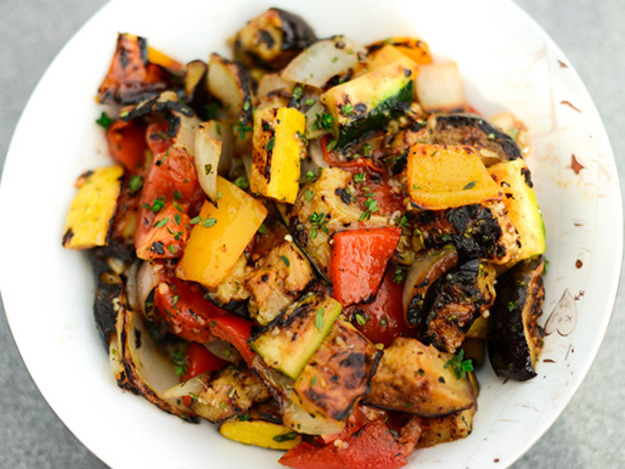
Yellow Crookneck Squash from T&D Willey Farm in California

From Livestrong:

Yellow squash is a versatile vegetable that provides you with several nutritional benefits and is used in many types of dishes.


Low Carbohydrates and Calories

Yellow squash is exceptionally low in calories, with approximately 20 calories in a small-sized vegetable and 30 calories in a medium-sized vegetable. The few calories in yellow squash come primarily from the carbohydrate content, which is also low. A cup of sliced, yellow squash contains approximately 4 g of carbohydrates. Yellow squash is a good option to replace high-calorie vegetables, such as potatoes and corn, in your nutrition plan, especially if you are trying to reduce your daily caloric intake.

Perfectly juicy Valenica Oranges from Sundance Growers

 From Paramount Citrus:

“King of the Juice Oranges”

For ultimate refreshment, try a Valencia Orange. Generally a summertime fruit, Valencia Oranges are heavy with juice and have a sweet, delicate texture. Known as the ultimate juice orange, a Valencia’s flavor is a perfect balance of sweet and tart.

New Crop Red Potatoes, thin skinned, great in potato salad

From eHow.com:

Around the world for hundreds of years because of their abundance, year-round availability, low cost and high fiber content. No wonder the average person consumes nearly 73 pounds of potatoes a year. Even though there are more than 5,000 varieties of potatoes in the world, red potatoes are one of the most common varieties, boasting impressive health benefits while adding a splash of color to your dinner plate.

Nice looking Field Cukes

From Gardening Channel:

Because cucumbers, like watermelons, are 95% water, they keep the body hydrated and help regulate the body’s inner temperature. They also help the body flush out toxins.

Leave the skin on. The skin contains a good amount of vitamin C, about 10% of the daily recommended allowance. If you do like your cucumbers peeled, the skin can be used to relieve sunburn and mild skin irritations, similar to aloe vera. There is some research indications that cucumbers can stimulate hair growth. Herbalists recommend cucumber juice to reduce puffiness around the eyes and to calm down acne.

Cucumbers can either relieve acid indigestion and heartburn or cause it, depending on the individual. They are a good source of dietary fiber.

How will you be using your favorite items this week? Please share your favorite items and recipes on our Facebook page

Happy Mother’s Day!

Happy Mother’s Day to all the Mom’s out there! I hope everyone will be enjoying this beautiful weather we are having this weekend, outside! I am not sure how many of you actually read the email I write each week, so I thought I would also include this in the blog. For those of you who do, this may be repetitive. Every year at this time, without fail I am asked why we don’t have more local produce and why there is not more variety? Two very contradictory things really. We buy as much locally grown produce as there is available for this time of year. Our season really does not kick in until June. For more variety than what we are offering, we would need to be buying more from Mexico or perhaps other hemispheres which is not part of our philosophy. My priority is always finding the best tasting, high quality produce with a balanced selection each and every week. I am happy to be providiing locally grown gorgeous asparagus each week, and offering it for sale for a great price if you wish to have more! Other items I am particulary excited about this week are: Yellow Summer squash, Artichokes, New Crop Valencia’s, loaded with juice and Peaches, from Mexico! I have traditionally waited for Peaches from California, but I tried one of these peaches the other day and it was fabulous! Here’s to a little more variety! Enjoy!
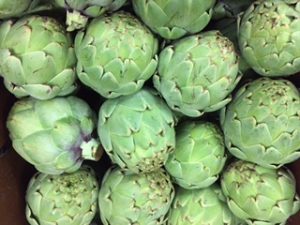
Here’s a little interesting lore on the Artichoke! Who knew there were Artichoke wars in NY and they were actually banned for a brief period of time! Read the article for the details!

It’s easy to forget that artichokes are largely a California phenomenon. Any dinner guest from outside the state will remind you of this: just notice the bewildered look on their faces as the artichoke is placed in front of them, followed by, “How do I eat this?” This is not an unreasonable question. In fact, the scaly looking vegetable is the bud of a mostly inedible thistle flower.

Artichoke consumption is an art: one scrapes the edible parts off of the many petal-like leaves (called bracts) folded around the bud, removes the then-exposed spiny florets at the base (also known as the choke), and eats the fleshy, flavorful heart. Observing the hedonism with which his fellow Romans devoured artichokes, Pliny remarked, “thus we turn into a corrupt feast the earth’s monstrosities, those which even the animals instinctively avoid.”

Despite Pliny’s grievances, artichokes have allured humans for more than two millennia. Thought to have originated in North Africa, where it is still found as a wild thistle, the artichoke traveled across the Mediterranean, seducing the Greeks, Romans and eventually Catherine de Medici, who popularized it in French cuisine. However, it remained unknown on this continent until a group of Italian immigrants planted a few hundred acres of the crop near Half Moon Bay in the late nineteenth century.

Quickly, artichokes became a popular delicacy in California and filled fields in Monterey County, where the temperate climate and deep, fertile soils provide a perfect growing environment. By 1920, farmers were shipping crates of artichokes by rail to the East Coast where their popularity exploded. Ciro Terranova, a member of the New York mafia, began cornering the artichoke market by buying all the crates coming in from California and reselling them at a 30 to 40 percent profit. Known as the “Artichoke King”, Terranova kept his profitable monopoly through intimidation of distributors, merchants and even growers. These “Artichoke Wars” escalated to such a degree that Mayor LaGuardia declared artichokes illegal in New York. However, LaGuardia himself could not resist the allure of the artichoke and after one week lifted the ban.

Fifty years later the artichoke was once again under scrutiny, this time not by gangsters and politicians but gastronomes. James Beard in a 1971 issue of Gourmet Magazine wrote, “There is a great feeling among serious wine drinkers that artichokes spoil the flavor of fine wines and therefore should be forbidden at great dinners.” His complaint was that a certain sweetness lingered on the tongue following its consumption. Artichokes contain a unique organic acid called cynarin, which stimulates sweet receptors on the palate, changing the character of subsequently consumed food and drink. Could this sweetness be part of the artichoke’s allure?

Source: CUESA (Center for Urban Education about Sustainable Agriculture)

Produce Report: Keeping it Green

Hello all and Happy Tuesday! Apologies for the delayed report. Nonetheless, this week’s produce arrived looking great.  We’d like to take this chance to showcase our local favorites in the bins. 

One of the more versatile vegetables is the radish. You can include them in just about every dish throughout the day. From radish bread to radish salad, there’s a way to make a radish dish all day. And they’re nutritious! The radish is a low calorie vegetable that has no fat or cholesterol and high in dietary fiber. They can make any dish look pretty.

Also coming in looking particularly great is the red chard, from Tom Zimmerman of Glory B Farm in Grays Harbor, WA.  These hearty and delicious greens stood out as soon as they arrived. They are a bit more delicate then the thicker, hardieer leaves that come with winter. Chard is also versatile.  Sauté the leaves with olive oil and garlic for a quick side dish. Add them to omlettes, soups and pastas for easy additional nutrition to your savory meals. You can even chop them very thin and toss into a salad!

Lastly, the asparagus is again gorgeous this week! Perfect long stalks, these bundles look ready to eat! They are excellent on the grill. Shake them in a bag with lemon juice, olive oil, salt, pepper and Parmesan cheese. Grill them until the cheese is melted and almost crunchy for a mouth watering side dish.

Now who’s hungry? We’d love to hear how you’ll be cooking your items from this week’s bins! Share your recipes on our Facebook wall!

Produce Spotlight: Local Radishes

Hello all and Happy Friday! Summer crops are starting just south of the California border, so anticipation builds as the seasonal harvest works it’s way up the coast.

 We are happy to be including those tasty little sweet Nante carrots from Something Good Farm in Santa Barbara, CA. They may not be the prettiest, but they definitely are the tastiest. Locally we are excited to have crisp Washington Asparagus for everyone!

We are also enjoying spring red round radish, from Siri and Son farm in Oregon, which are mild and not too spicy. Many people don’t realize how versatile the radish is. Also known as the Magic Root, the radish grows quickly. In just three weeks, a radish is fully-grown and ready to eat!

Nutritionally, the radish is a low calorie vegetable that has no fat or cholesterol. With very little sodium and no protein, radish nutrition facts reveal that the major nutrient contained in ½ cup of radishes is dietary fiber. With 2 grams of carbohydrates, however, one serving of radishes will keep you full of energy.

Radishes can be used in a variety of ways. Already great for salads or cooling down your mouth after eating spicy food, the radish holds more ground than you may think. From radish chips to radish curry to even a radish tart, these little roots can be in just about any meal throughout the day.

Our favorite recipe? Slice them paper thin to adorn salads or roast them on the grill for a totally different flavor.

How will you be eating your radishes next week? Share your recipes for the radish and all of your favorite items on our Facebook page!

REMEMBER – Rhubarb is available for sale again if you are a lover of a good rhubarb crisp as I am!  Another local item we are adding to this week’s bin which is Red Chard from Tom Zimmerman of Glory B Farm in Gray’s Harbor, Washington.

Have a fantastic weekend!

Beautiful Produce This Week!

Hello all and Happy Hump Day! The week is almost over, but we wanted to share some great photos of this week’s bins. They look great!

The Yukon potatoes from California are in prime condition. I cannot wait to make a fresh batch of gratin with these! The Washington new crop potatoes will be in sometime in June or July, so expect those in the coming months.

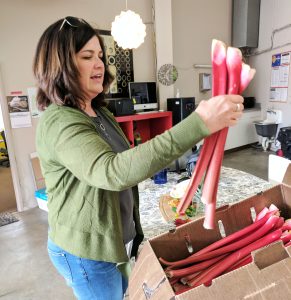
The local rhubarb came in absolutely beautiful this week and leaf free so that there is no confusion. Remember, the leafy part of rhubarb is poisonous and not to be eaten. Check out the stems gorgeous red color shining in the sun!

We can’t wait to hear how you used rhubarb this week and would love it if you shared on our Facebook wall!

And lastly, we wanted to include this picture of a teeny tiny baby radish we found inside one o the bunches. Radish may be my favorite item this week!

What item do you like best this week? Share your favorite items, ones you want to see more of, and recipes you drool over on our Facebook wall! Sharing is caring after all. 


Spring is here with local rhubarb!

Hello All and Happy Weekend! We are very excited as Spring and Summer harvests are beginning to crop. California crops are building anticipation as the seasonal harvest works it’s way up the coast.

Locally we are enjoying spring radish, which are mild and not too spicy. Slice them paper thin to adorn salads or roast them on the grill for a totally different flavor. Also rhubarb is available for sale, and we have leeks leeks and more Leeks, Asparagus, & Cauliflower!

Rhubarb specifically is a sign the Spring is here and Summer is near. It is an acquiredveggie of sorts. And can be very intimidating due to its toxic leaves. However, rhubarb is incredibly versatile. Its stalks are great in stew, as a sauce, in pie or even candied!

It is also high in fiber, vitamins C & K and calcium! Plus, it is low in sodium and saturated fat.

Keeping it local, we always buy Washington apples and pears, but those as you may or may not realize are from last year’s crop. They are harvested between Aug and October and then the hardiest varieties are chosen for CA, or controlled atmosphere storage. This is a common practice done everywhere so they can extend the crop supply throughout the year.

This is the last week for pears, except for the fruit only bins, and we will most likely have apples until the summer stone fruit crops start arriving. The Fuji’s we have been getting lately are firm, dense and delicious! So stock up!

What item are you most excited for this week? Share your thoughts and favorite recipes on our Facebook page


Produce Report: Loving the Local Goods!

Hello all and Happy Monday! The produce arrived looking great this week! Our local asparagus in particular signifies Spring is in the air! And it looks ready to eat! Sauté or grill your asparagus with a little olive oil, salt, pepper and Parmesan cheese for a quick and delicious side dish.

Also looking beautiful and colorful are the red peppers and navel oranges! Check out how vibrant these two look together. And while you may not pair them immediately, both are delicious in a salad!

Now, we’d like to write a short note about diversity in the bins.

We’ve mentioned it many times already, but feel it’s important to keep repeating.
Spring is transition time! Yes, there is less variety this time of year especially compared to summer for very legitimate reasons.

In California, many winter crops are over and summer crops have not yet begun. Locally, there is not a whole lot happening yet and what is growing and being harvested we are putting in the bins.

If we were to be more diverse this time of year, that would mean we would be buying more from Mexico and farther south in South America, which does not align with our mission.
On a positive note, it looks like we are in for a great local season and we look forward to bringing you some fantastic Washington and Oregon grown fruits and vegetables.

Eat well and enjoy!

Earth Day & More.

Hello all and Happy Friday! Earth day is this Sunday! New Roots is excited to be participating in a family Earth Day fair on Mercer Island, called Leaf for Green, which is focusing on food this year.

This week’s bins will also be helping to commemorate Earth Day with a hearty serving of  local veggies. Local spring items in next week’s bin are: Collard Greens, Cabbage Raab, Leeks, Asparagus, and Cauliflower.

For those of you who missed out on last week’s Cabbage Raab, it is back and sodelicious! This bouquet of cabbage buds may look intimidating and quite questionable at first, but do not fear. This green should be treated like all the others. They are great in soups, salads, casseroles, or sautéed with a little olive oil, salt and pepper.

Factoid of the Week: As always, we’ll be having Washington apples and pears, however you may or may not realize are from last year’s crop. They are harvested between August and October and then the hardiest varieties are chosen for CA, or controlled atmosphere storage. This is a common practice done everywhere so they can extend the crop supply throughout the year. This may be the last week for pears, and we will most likely have apples until the summer stone fruit crops start arriving! Enjoy them while we can!

How will you be celebrating Earth Day? Share your Green tips on our Facebook page to help spread the word! 

Produce Report: So many goodies!

Hello all and Happy Monday! This week’s produce is coming in mighty fine. As wetalked about in Friday’s blog, one of our favorite treats this week is the Cabbage Raab. With tender leaves and flowering buds, ALL of the Cabbage Raab is edible and quite tasty! Just sauté them up like you would any other green.

We also have the “full size” purple beets this week. And they came in absolutely gorgeous today! Don’t forget the beet greens are totally edible as well. Chop the tops up and sauté them with a little garlic and oil for a quick side dish. If you have the barbeque going, you can par-boil the beets, wrap them in foil and put them on the grill to finish them. Fantastic for Spring!

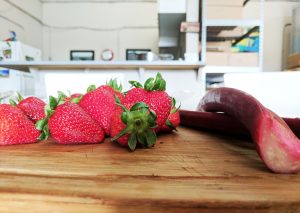
While we are still in transition between Winter and Summer crops, one good sign Summer is soon on its way is this week’s batch of strawberries. Beautiful, bright and ready to eat, these strawberries will leave you wanting more! Juice them, add them to your waffles, bake a pie, or just eat them out of the bin!

What will you be creating this week? We would love to hear and share it! Describe your culinary masterpieces on our Facebook page! No dish is too simple or extravagant; us foodies love it all!


Produce Spotlight: Local Cabbage Raab

Hello all and Happy Friday! We have quite the special item this week that we cannot wait for you all to try! Cabbage Raab is a unique and beautiful local cabbage. It may look like a bouquet of roses with leaves as petals, but I assure you it is fantastic!

“Raab” is something we have every spring from various local farmers and it is basically the early growth of from over wintered crops like Kale, Collards and Cabbage. Other than trimming off the bottom of the stems where they were cut, you can eat the whole thing, including the flowering tops (if you are lucky enough to get those!)

Don’t shy away from trying these out. They are easy to make and delicious as a side. My favorite way to enjoy it is to sauté it with garlic and olive oil and some finish with a pinch of good salt. But it can be blanched, or steamed as well.

Try it out and let us know what you think on our Facebook page!